by Kate Stanton-Davies, Director, Water Loss Research & Analysis Ltd
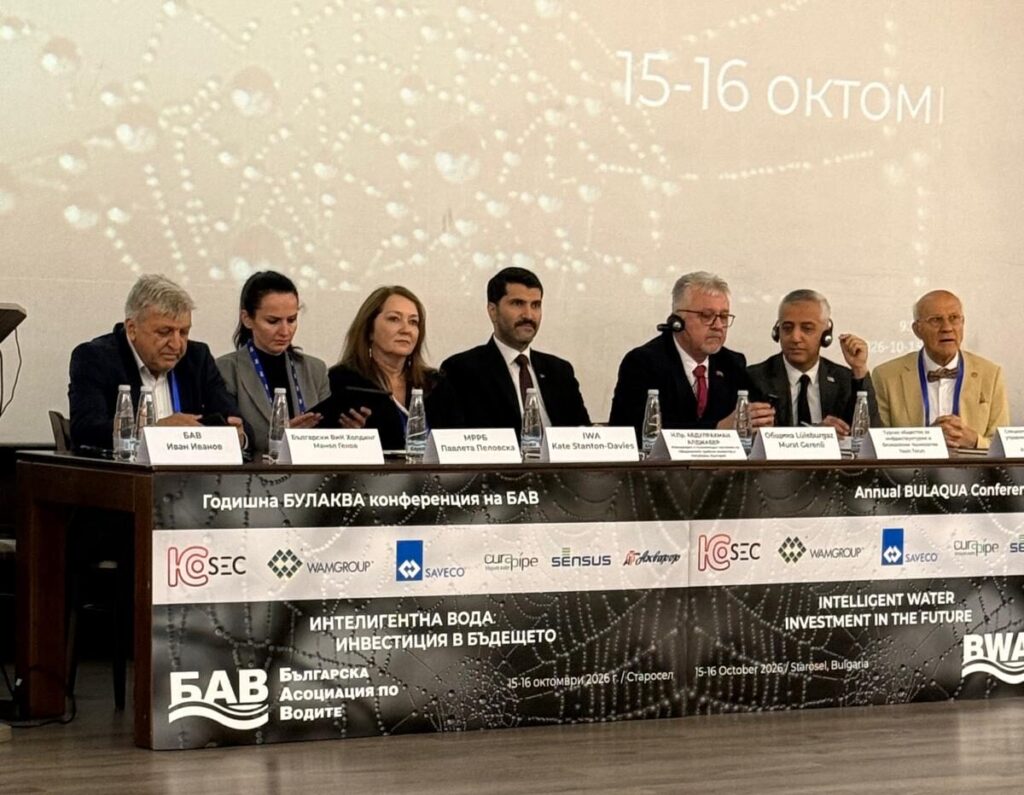
In October I delivered the keynote and two technical sessions at the Bulgarian Water Association’s BULAQUA conference in Starosel, on behalf of the IWA Water Loss Specialist Group. Over two days, one question kept coming back: how do we pay for, and deliver, serious reductions in non-revenue water (NRW)?
For me, three presentations stood out. Two brought real numbers: Constanța in Romania and Devin in Bulgaria. The third, from Croatia, explained what utilities need in place before digital tools and AI can add value. They use very different tools, but the lessons overlap.
Why Romania’s experience matters to Bulgaria
Romania and Bulgaria joined the EU on the same day in 2007. Both work to the same obligations, including Drinking Water Directive (EU) 2020/2184. Both still have a long way to go.
In 2024, sector-wide NRW was around 44% in Romania and around 60% in Bulgaria. Both countries face ageing infrastructure, less EU funding and heavy investment needs. Romania’s estimate is EUR 30.4 billion over 15 years. NRW sits in the middle of all of it, because every cubic metre lost has to be treated, pumped and paid for.
Constanța: pay for results, not activity
Pedro Ramalho of AGS Water Solutions presented the performance-based service contract (PBSC) at RAJA, Romania’s largest regional water operator. The project area covers around 265,000 inhabitants in Constanța municipality and about 700 km of network.
The contract structure is the clever part:
- Year 1: a fixed fee while the baseline is established.
- From year 2: a performance fee tied to results, with the fixed fee falling over time.
- Independent technical auditor to verify results.
- EBRD funding.
- KPIs covering NRW in old and new zones, the Infrastructure Leakage Index (ILI) and pipe breaks.
The starting point will be familiar to many utilities: an open network with no DMAs, incomplete metering, data on paper and reactive repairs only.
The results:
- 17.4 million m³ a year of NRW removed.
- ILI down by 37 points.
- About 24% lower energy consumption.
- 3,528 tonnes of CO₂ a year avoided.
- 150+ chambers built, 245+ flow meters and 485+ pressure sensors installed.
- 90 of 91 planned DMAs in place.
- Active leakage detection scaled up: inspected network grew from 187 km in 2021 to 1,235 km in 2025, and operational staff working on water losses grew from 11 to 23.
On apparent losses, the team improved customer data, tested meters in a laboratory, introduced dedicated meter-management software and inspected for irregular use.
What I took from it
Clear practical lessons – set realistic targets, define clear roles, agree a baseline, resource the work properly and keep every stakeholder talking. The main challenges were people and organisational change, not technology. Digital transformation was essential, and so was involving people from management to the field.
Devin: fixing many defects with minimal street excavation
Peter Paz of CuraPipe presented a white paper, prepared with PipeTechnik, on Devin, a town of around 34,000 people in hilly terrain. Its network includes asbestos cement (AC) pipes with leaking joints and collar displacement, and cast iron pipes with corrosion pits. It shows high, variable night flows.
The approach was data-led before it was technical:
- Divide the network into 13 monitoring zones.
- Analyse night-flow and pressure data.
- Confirm with field inspection.
- Select zones for treatment.
The treatment was Trenchless Automated Leakage Repair (TALR). A launcher unit connects to a hydrant or access point, and a pig train travels through the pipe, treating multiple active defects from the inside in a single run. Works took place in October 2025, with minimal street excavation.
The results:
- Minimum night flow fell from 19.5 L/s to 12.0 L/s, about 38%.
- Losses in treated zones fell about 90%, from roughly 34,000 to 3,400 L/h.
- About 8 L/s recovered, as a reported estimate.
What matters is that the measurement came first and last: zone selection from flow data, and verification from flow data. That is what turns an interesting technology into a credible result.
The paper is careful to say the method suits AC and other pipe materials with similar defect types, subject to network assessment. It is a targeted tool, not a replacement for a sound leakage strategy.
Preparing for AI: start with the foundations
Dragan Sokolovic, Co-founder and CEO of Smart Aqua (Pula, Croatia), opened with three problems every utility will recognise. The customer calls again because nobody has a shared repair status. The crew cannot find a valve because the knowledge sits with one experienced colleague. The night repair is finished, but nobody has checked whether night flow actually fell.
His point: AI is advancing quickly, and it can spot patterns, interpret field notes and photographs, rank inspections and draft summaries. But technology moves faster than utilities are ready for it, and readiness decides the value.
Change is not transformation
Putting paper repair reports into digital forms improves how we work today. Transformation redesigns the work, so that reporting, intervention, measurement and verification become one managed process. Data held in separate silos (GIS, SCADA, customer systems, ERP, field records) has to become one shared operational context.
One case record, from leak report to verified result
He showed a single case record following each job across teams, from signal to check, detect, assign, repair, verify and close. It carries the asset ID and location, owner and priority, timestamps, field evidence, customer impact and the measured result. So the repair is an activity, and the verified outcome is the management result.
Why AI needs reliable data
An unusual night flow in a DMA is a signal, not a confirmed leak. To interpret it, a system must know whether it is looking at the same asset across GIS, billing, ERP and field records, understand the context (pressure, legitimate demand, valves, recent works), and trust the source and its quality. Without that, AI simply speeds up bad decisions.
People are the critical infrastructure
Field teams act as walking sensors, capturing photographs, valve condition, access constraints and repair evidence. Office teams maintain case status and validate data. Management sets priorities, owns the process and removes barriers between departments. The skills to build are ownership and working habits, not just software proficiency.
A pilot at ViK Ruse
Between March and September 2025, ViK Ruse piloted digital coordination in two DMA zones (Nikolovo and Tsvetnitsa). A roughly 90 km active leakage control sprint found 71 leaks. The pilot demonstrated coordinated records and better operational visibility. Dragan was clear that verified NRW savings would need a separate baseline, which is an honest caveat worth repeating.
Where AI fits: evidence first, people accountable
His model for AI in an NRW process has six steps: detect the signal, validate it (meter health, missing values, DMA boundary), add context, let AI summarise the evidence and suggest an inspection priority, have an authorised person accept, correct or reject it, then inspect, repair, verify and record. The questions to ask are what evidence, who approves, and how the result is verified.
His suggested next step for utilities is to assess, run a focused 90-day improvement, review and then scale.
Common messages across all three presentations
A 17-million-m³ programme, a single town’s trenchless repair and a digital pilot look very different. Yet all three:
- Started with measurement. Metering, zoning and data came before action.
- Targeted effort where the data showed the biggest losses.
- Verified results with independent or before-and-after flow data.
- Needed people, not just kit.
Technology and contracts only deliver when the foundations of people, processes and data are in place.
What next
With Directive 2020/2184 requiring real-loss reporting and leakage thresholds to follow from 2028, Bulgarian utilities have good reason to act now. The tools, the contracts and the local case studies exist. The next step is to put them to work.
My thanks again to the Bulgarian Water Association and its Water Loss Specialist Group, and to Pedro Ramalho, Peter Paz and Dragan Sokolovic for allowing me to draw on their presentations.
The views expressed in this article are the personal opinions of the author.
Sources: RAJA / AGS, “RAJA’s Constanța experience in implementing innovative NRW solutions: results and lessons learned” (BULAQUA, October 2026); CuraPipe and PipeTechnik, “Devin, Bulgaria: From Physical Water Loss to Recoverable Supply”, white paper draft v1.0 (October 2026); Dragan Sokolovic, Smart Aqua, “Preparing Water Utilities for AI: Digitalization of Water Loss Management as a Starting Point” (BULAQUA, 2026).

Leave a Reply